
Win the neighborhood. Not the price war.
Local search and AI Search built for independent gyms. The floor visible, the community legible, membership transparent, so a prospect picks you over the budget chain on reputation, not on the cheapest monthly rate. Running through the software you already use.
 Built to win the neighborhood
 Fighting a chain
on the chain’s terms.
The independent wins on the room, the coaching, and the community, everything a franchise template can’t fake. Most gym sites give none of it away. Three patterns show up on nearly every independent we audit.
- / 01
The site competes on the one axis you lose.
The budget chain down the road will always be cheaper, and a site that leads with a monthly rate is fighting on the only ground where $10-a-month wins. The independent’s real edge, the coaching, the community, the equipment, the room itself, is nowhere on the page, so the prospect has nothing to compare but price, and picks the chain they’ve heard of.
- / 02
The floor and the community, your whole moat, are invisible.
One stock photo, no shots of the actual members, no coaches named, no classes shown. The prospect cannot tell your gym from a franchise template, so the thing that would make them choose you never reaches them. The room that earns the membership stays hidden behind a "book a tour" button.
- / 03
Your Google listing is leaking the map pack.
"Gym near me" is decided in the three-listing local pack, and that pack takes the overwhelming majority of the clicks. Most independents run an unclaimed, half-complete, photo-starved profile and lose the pack to chains with full-time marketing teams, every month, for years, without anyone catching it.
How prospects
actually search.
"Gym near me" is the volume; the comparison search is the conversion. The queries split into the prospect ready to join the closest real gym, and the one deciding whether you are worth more than the chain. A winning site speaks to both.
"Gym near me."
The highest-volume local search there is, and it is decided in the three-listing map pack. They want hours, location, membership, and a fast read on whether the room is real. Own the pack in your radius and you get the clicks; sit below it and a chain takes the membership.
- gym near me
- [neighborhood] gym
- 24 hour gym near me
- gym with [amenity] near me
- best gym in [city]
"Is it worth it?"
Researching before they commit, weighing you against the budget option, and increasingly asking AI tools to do it for them. They read the reviews and ask ChatGPT for the best gym in the area. Answer the comparison on your site and you get cited. Hide behind a price and you do not.
- best gym in [area]
- is [gym] worth it
- [gym] vs budget chain
- gym with personal training [area]
 The room is the difference
 Sell the room,
not the rate.
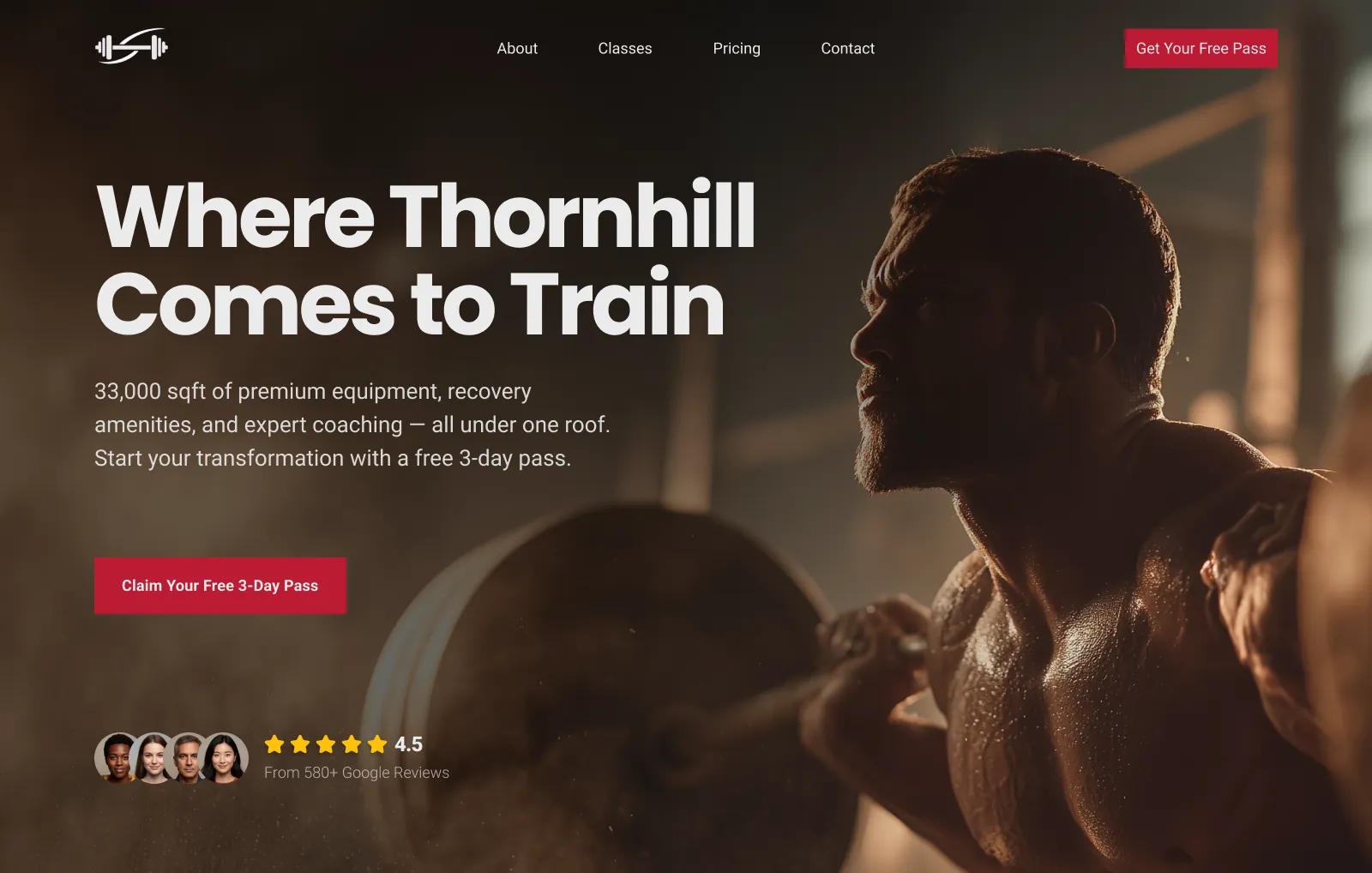
An independent gym site has two jobs: make the room, the coaching, and the community legible in under ten seconds, then get the free pass before the prospect leaves. Real photography of your floor and your members, membership shown openly, the trial offer impossible to miss. You will never be the cheapest. The site’s job is to make sure you do not have to be.
- Real photos of the floor, the equipment, the members, and the coaches, not a franchise stock set
- Membership pricing and what is included shown on the site, not gated behind "contact us for a tour"
- Free pass or trial offer above the fold and one click from any page
- Coaching, classes, and amenities surfaced as the reason to pick you over a budget chain
- Coach bios with the credentials that actually sell, strength, nutrition, sport-specific
- Hours, location, parking, and "what to expect on day one" answered plainly
- Reviews surfaced on the site that name coaches, classes, and the community
- Membership and trial signups integrated with your platform (Mindbody, Mariana Tek, Glofox, GymMaster, PushPress)
How it works
for the floor.
Three workstreams, tuned to the way gym prospects search. For an independent, the Business Profile carries more weight than anywhere else, the map pack is where the neighborhood decides, and it is the one place a single location can out-rank a national chain.
Google Business Profile
For a gym, the map pack is close to the whole game, "gym near me" is decided in those three listings. Claimed, complete, and photo-rich with real shots of the floor and the coaches, posts when hours change or a promo opens, and review responses written by a human. This is the single most valuable asset an independent has, and we run it on retainer so it stays ahead of the chains.
On-site content shape
Pages for membership, classes, personal training, and amenities, plus coach pages that name the credentials. An FAQ that handles hours, contracts, parking, and day-one nerves in plain language. Built so you rank for "[neighborhood] gym" and "gym with [amenity]," not just for people who already typed your name, and so the prospect comparing you to the chain finds the reasons to choose you.
AI Search visibility
The comparison queries, "best gym in [area]," "is [gym] worth it," "[gym] vs the chain," are exactly what ChatGPT and Perplexity now get asked before someone joins. Those tools cite gyms that answered the question on their own site and whose reviews name the coaches, the classes, and the community. We build the content layer and coach the review-ask so when a prospect asks for a recommendation in your area, your gym is in the answer.
What moves when the room
does the selling.
The three numbers we watch for an independent gym: profile interactions, free passes claimed, and new members. They move in that order.
Profile Interactions
Trial bookings
New Members
Figures are representative of the trajectory we target for gyms three months into an engagement, not a guarantee. Local search is patient; we report the real line monthly.
Gym marketing,
answered.
The questions independent owners ask before they sign. If yours isn’t here, the audit will surface it.
- We cannot compete with the budget chains on price. How does this help?
- You do not compete on price, you compete on the thing a chain cannot copy. The site’s job is to make the coaching, the community, and the room legible so the prospect compares on value instead of on the monthly rate. The people who choose an independent over a $10 chain were never going to be won on price; they are won on whether the gym looks like somewhere they would actually belong, train hard, and stick around. We build the site to show that in the first ten seconds, and we stop spending the home page apologizing for not being the cheapest.
- We are a single location. Does local SEO really move the needle?
- More for you than for almost anyone. "Gym near me" is one of the highest-volume local searches there is, and it is decided in the three-listing map pack, not on page two of Google. A single, well-run location that owns the pack in its radius beats a national chain with a diluted profile every time, because the pack is local by definition. The whole game is winning the few hundred "gym near me" and "[neighborhood] gym" searches that happen around you every month, and that is exactly the kind of fight a single location can dominate.
- Should we actually put our membership prices on the site?
- In almost every case, yes. Gating pricing behind "contact us for a tour" was a 2010 tactic built to get the prospect on the phone, and today it mostly sends them to the gym that showed the number. Showing pricing, and, just as important, what is included, pre-qualifies the lead so the people who do reach out are ready, and it signals confidence. If your value is real, the price is part of the pitch, not something to hide. The exception is if you sell almost entirely through in-person consults for high-ticket coaching, and even then we usually show a starting point.
- We run on Mindbody / Glofox / PushPress. Do we have to switch?
- No. Mindbody, Mariana Tek, Glofox, GymMaster, and PushPress are the platforms we see most often in independents, and we integrate with all of them. Your members already have logins, your billing is configured, your front desk knows the system, and the back-office cost of switching is rarely worth it. We make the site send free-pass signups and membership inquiries into the platform you already run, tagged so your team can follow up. If you are on something less common, we can usually integrate that too, the audit will tell you what is possible.
- How do we get more out of our free-pass or trial offer?
- It is usually a website problem before it is a sales problem. Most gyms either bury the free pass three clicks deep or never explain what the prospect actually gets. We put the offer above the fold, repeat it through the site, say plainly what a first visit looks like, what to bring, what to expect, whether someone will show you around, and feed signups into your system tagged so the front desk follows up fast. The intimidation gap closes a lot of trials before staff ever sees them; closing it on the page is where the lift comes from, usually inside the first ninety days.
- How does AI Search affect independent gyms?
- More than most owners expect. The comparison questions, "best gym in [area]," "is [gym] worth it," "[gym] vs the chain," are exactly what people now ask ChatGPT and Perplexity before they join, instead of opening ten tabs. Those tools cite gyms that answered the question on their own site and whose reviews name the coaches, the classes, and the community. A gym with a real site and review density gets pulled into the recommendation; a gym with a franchise template does not. Almost no independents have built for this yet, which is exactly why the window is open.
See what’s costing your
gym the next membership.
Five-minute Loom walkthrough of your site and search presence, emailed back within 24 to 48 hours. No call required.
Get my free audit