

TL;DR: The four gym marketing channels with the highest return for local gyms and studios are local search, Google reviews, a website built to convert, and a structured referral system. Most budgets go to paid social and Instagram, the most expensive channels with the shortest shelf life. This article explains why those underperform, and how to sequence the four gym marketing channels that actually compound, even when you can only start one at a time.
You have tried the marketing. Instagram got you some likes and no new members. Meta ads burned through a budget and maybe produced a lead or two, nothing you could repeat. The flyers brought in nothing you could trace.
Here is the part most owners miss. The problem is rarely budget or effort. It is channel selection. A gym marketing strategy fails when it spreads attention across channels where nobody is actually deciding to join a gym. Most gyms market where attention is easy to get, not where their next member is already looking. The channel that moves a local fitness business is intent-based, not attention-based.
Why most gym marketing strategies don’t produce consistent members
The most common mistake is running too many channels at once, none of them deeply enough to work. When budget and attention split five or six ways, no single channel gets the sustained investment that actually produces members.
Most gyms run five to seven things at the same time:
- Posting on Instagram
- Facebook and Instagram ads
- Google Ads
- Flyers and local print
- Groupon or deal sites
- The occasional referral ask
- Email blasts
Each one gets a thin slice of money and almost no follow-through, so none of them ever reaches the point where it pays off. The fix is not a bigger budget. It is a narrower plan with more depth on fewer channels.
Where does a gym member actually find you before they sign up?
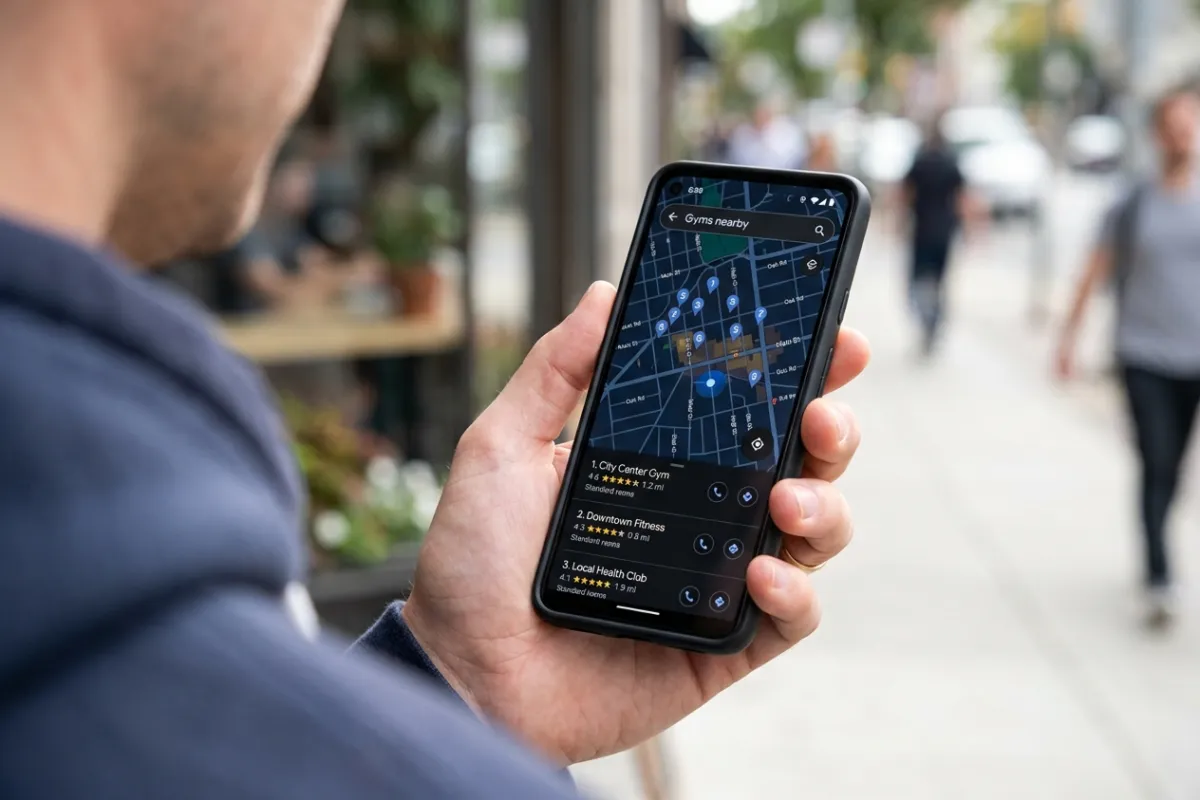
Most often, Google. Not Instagram, and not a Facebook ad. Google Maps and Google Search, at the moment someone decides to start looking for a place to train.
There is a real difference between an attention channel and an intent channel. On Instagram or a paid feed, people are scrolling, not shopping. On Google Maps and Google Search, they have already decided to find a gym and are choosing between options. Intent channels find the buyer after they have decided to change. Attention channels catch them before they have. That timing gap is why local search converts at a different rate than social media.
There is also a newer place owners are getting found. A growing share of people now ask an AI tool for a local recommendation before they ever open a map.
Channel 1: Local search (the foundation)
Local search is how your gym shows up when someone nearby looks for a place to train. It has two parts. There is Google Maps, driven by your Google Business Profile (the listing that appears when someone searches your gym name or “gym near me”), and there are the organic results below the map, driven by the words and the code on your own site.
A gym sitting in the top three of the map results for “gym near me” in Austin or Denver catches ready-to-act clicks around the clock. There is no cost per click, and no budget that vanishes the moment you stop paying. That is what makes local search the foundation the rest of your local fitness marketing sits on.
What the setup actually takes:
- A complete, accurate Google Business Profile with the right primary category, current hours, and real facility photos
- Page titles and headings that name your service and your city
- Consistent name, address, and phone details across directories like Yelp, Apple Maps, and Bing Places
This is the groundwork behind our local SEO setup for gyms and studios, and it is the single highest-return place to start.
Channel 2: Google reviews (the trust multiplier)
Reviews do two separate jobs at once. They lift your local ranking, and they convert the visitors who found you through search. A gym with 4.8 stars and 120 reviews converts more of the same traffic than a gym with 3.9 stars and 14 reviews, even when the number of visitors is identical.
Review signals make up roughly 16 to 20% of what Google weighs for the local map results. So every new review nudges your ranking up and your conversion rate up at the same time. Each new review improves both inputs at once.
That is the compounding part. More reviews means better ranking, which means more traffic, which converts at a higher rate because the reviews are also doing the convincing. The mechanism is active review generation, not passively waiting for one to show up. A short text to a member at the 30-day mark is the minimum version, and it works.
Channel 3: Your website (the conversion engine)
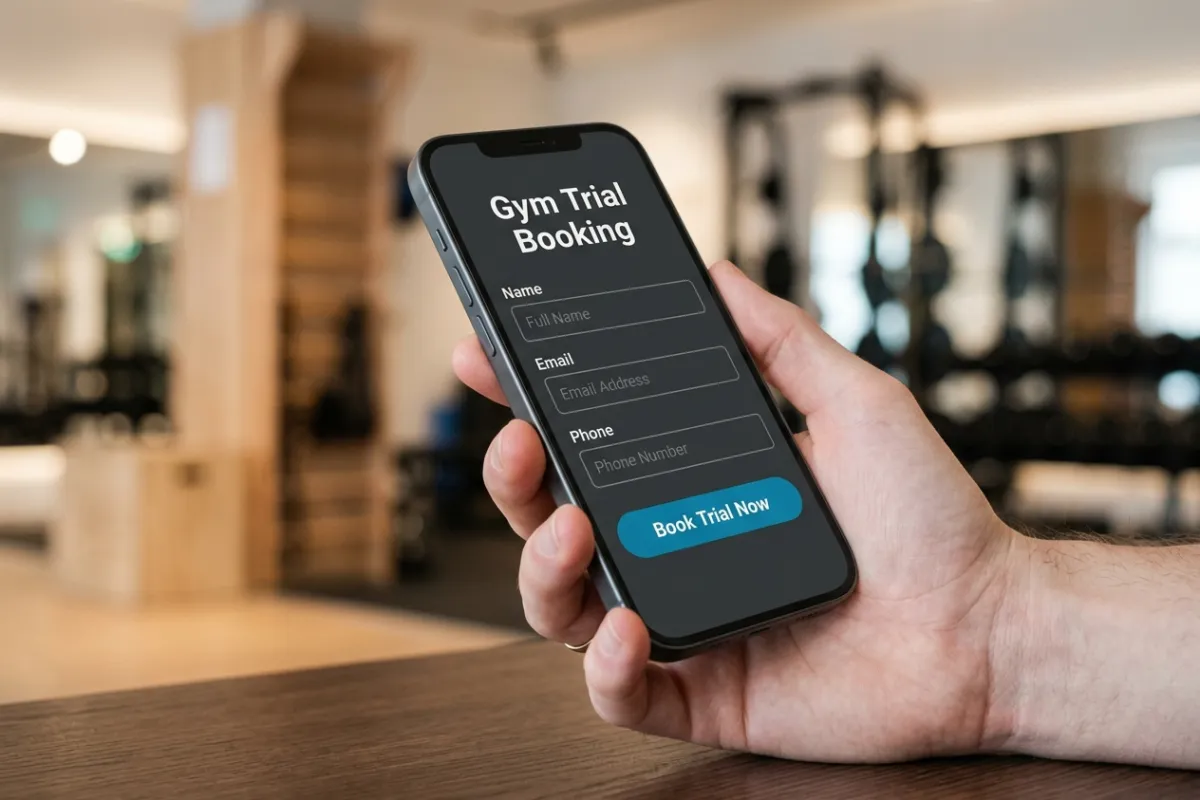
Your website is not a channel in the usual sense. It is where every other channel sends people. That makes it the highest-stakes asset in the whole plan. Push your trial booking rate from 2% to 6% and you triple the output of every other channel without spending another dollar on any of them.
What makes a gym website actually convert:
- One clear action per page, like booking a trial, instead of five competing buttons
- A booking form with no more than three fields
- Real facility photos and real Google reviews on the homepage
- A site that loads in under three seconds on a phone
If you want the longer version of what “converts” really means for a gym site, we wrote it up in why most gym websites don’t bring in new members.
Channel 4: Referral systems (the ceiling-breaker)
Word of mouth works. The problem is that it is passive. The organic version waits on a member to mention you to a friend who may or may not act. A structured referral system turns more of those conversations into actual sign-ups.
The simplest version is a direct ask at the 60-day mark, when a member is most invested, paired with a specific offer. A $50 account credit when a referred friend finishes a 30-day trial is simple and easy to measure. The cost per referred member usually comes in below a paid social lead.
Referrals also have a limit. The number a gym can generate tracks the size of its current member base, so it grows slowly and shrinks when members leave. That ceiling is exactly why referrals work as the top of the system, not the base of it.
Should you run paid social and Instagram ads for your gym?
Not as your first move. Add paid social only after local search, reviews, and your website are already working. Run it before that and you are paying to send traffic to a site that cannot convert it.
Paid social is not a bad channel. It is a wrong-sequence channel. Running Facebook ads before the foundation is in place means paying twice, once for the click and once for the conversion you then lose. Running paid ads into a site that doesn’t convert is pouring water into a leaking bucket. Once channels one through three are working, paid reach extends a foundation that already turns visitors into members. That precision matters. Some owners run effective paid social, and the point is timing, not a ban.
How do you sequence all four channels if you can’t do everything at once?
Start with local search, since it compounds quietly in the background while you work the rest. Collect reviews in parallel from month one. Fix the website in month two. Add the referral system by month three. That order is also the simplest honest answer to how to market a gym without spreading yourself thin.
- Month 1: Google Business Profile and local search setup (Channel 1)
- Months 1 to 2: an active review collection push (Channel 2)
- Month 2: website conversion fixes, the action, the form, the mobile speed (Channel 3)
- Month 3: a structured referral program with an ask script and an incentive (Channel 4)
Most of the local SEO work we do for gyms in the first 30 days is exactly this month-one setup, because it is the piece everything else stacks on.
The takeaway is not that Instagram or ads are useless. It is that order beats effort. Build local search first, stack reviews on top, make the website convert, then add referrals. Each one makes the next work harder. The best marketing for gyms is rarely a new channel. It is the right four, built in the right order.
Frequently asked questions
What’s the fastest gym marketing channel to see results from?
Google reviews tend to deliver the fastest compounding effect. A targeted ask to current members, like a text at the 30-day membership mark, can produce 10 to 20 new reviews within a few weeks, and each one lifts both ranking and conversion. Local search takes 60 to 90 days for visible ranking shifts, but reviews often improve conversion faster because they act on traffic the gym already has.
How much should a gym spend on marketing per month?
The highest-return gym marketing is less about total spend and more about sequence. Local search setup and reviews take effort, not ongoing ad budget. A website conversion fix costs less than one month of Facebook ads and usually recovers more revenue. Until channels one through three are producing, keeping paid ad spend near zero is the right move for most independent gyms and studios.
Should I run Google Ads or Facebook Ads for my gym?
Both are reach channels, not foundation channels. Google Ads can work once your website converts well, because you are paying for ready-to-act traffic your site can close. Facebook and Instagram ads work best as a top-of-funnel layer once the rest of the system converts. Neither replaces local search for durable results. The sequencing question matters more than the channel choice.
How long does local SEO actually take to work for a gym?
Google Maps improvements show up earliest, often 30 to 60 days for a gym starting from a complete, accurate profile. Organic ranking shifts take 60 to 90 days to become meaningful. The honest benchmark: a gym with a strong profile, 50 or more reviews, and a website built to convert typically sees measurable trial bookings within 90 days of a full local search setup.
My gym runs mostly on referrals. Do I still need local search?
Yes, because referrals have a ceiling. The organic referral rate tracks the size of your current member base, so it grows slowly and drops when members leave. Local search finds members who have no existing connection to your gym at all. The two channels reach different pools, and relying on referrals alone leaves the larger, higher-intent pool untouched.
Not sure which of these four channels is your biggest gap?
The free instant audit shows you exactly where your gym’s Google presence stands, with results on screen in seconds and the top fixes emailed right away. Get my free local SEO audit.